Learning English is exciting, but it can also be hard. Many students tell me the same thing:
“I understand English, but I can’t speak it.”
This is a very common problem. You listen to English videos, read texts, and study vocabulary. You understand many words. But when you try to speak, your mind goes blank. You feel nervous or slow. This means you need to build your English speaking confidence.
🎧 Why Understanding Is Easier Than Speaking
Understanding English is easier because you don’t need to talk. You can guess the meaning. You can use pictures or context. You can take your time.
But speaking is different. When you speak, you must:
remember words quickly
make sentences
think about grammar
feel confident
That’s a lot to do at once!
🧠 “I Know It, But I Can’t Say It”
Many learners have passive English. This means they know words when they hear or read them, but they cannot use them when speaking.
This happens when you:
only listen or read
don’t practise speaking
feel shy or afraid of mistakes
study words but don’t use them
To improve, you need to grow your English speaking confidence step by step.
💡 How to Build English Speaking Confidence
You don’t need to be perfect. You just need to use English more often.
Try these ideas:
speak for 30 seconds every day
write short sentences with new words
record your voice
speak to a friend or teacher
don’t worry about mistakes — they help you learn
The more you use English, the easier it becomes.
✏️ Free Worksheet: From Knowing to Using English
Use this worksheet to practise using words you already know. Email me for the answers!
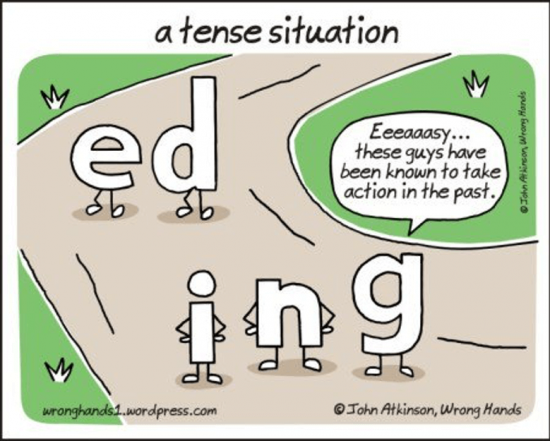
In the past simple tense, regular verbs end in ‘ed’. There are three different ways of pronouncing these two little letters – / ɪd /, / d / and / t /.
First, let’s look at the / ɪd / ending.
Regular verbs that end in the sound / t / or / d /, in the past simple the ‘ed’ ending is pronounced / ɪd /. Here are some examples:
Examples:
start – started
invite – invited
want –wanted
need – needed
decide – decided
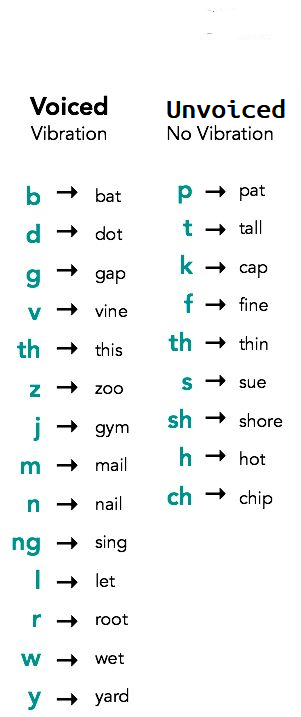
Secondly, the pronunciation of the ‘ed’ ending for other regular verbs in the past simple depends on whether the last sound of the infinitive of the verb is voiced or not. Regular verbs that end in voiced sounds will have / d / as the pronunciation of the ‘ed’ ending in the past simple. Here are some examples.
And finally, regular verbs that end in unvoiced sounds will have / t / as the pronunciation of the ‘ed’ ending in the past simple. Here are some examples.
Examples:
jump – jumped
kiss – kissed
wash – washed
look – looked
watch – watched
To summarise, there are three different ways to pronounce the letters ‘-ed’ for regular verbs in the past simple and the way to choose how to pronounce them, depends on the final sound of the infinitive.
Learning another language can be complicated. But with the right tools and a patient tutor, it will become less frustrating.
These 5 tools will help you in between lessons with your tutor:
Flash Cards – You can make your own flashcards quite easily. Focus on what you need help with the most: spelling, pronunciation, grammar rules, etc.
Visual and Audio Aids – As part of my lesson, I always send the lesson material and a copy of the words to practice. This will be a word document that the student can follow together with an MP3 audio clip with the correct pronunciations.
Translators and Dictionaries – Using an app on your phone or PC together with your bilingual dictionary will go a long way to help you with some difficult words while reading or doing homework (and your tutor is not available)
Word of the Day – With this activity, you will start your own little phrase book. It helps increase your vocabulary and master your spelling and pronunciation.
Conversation Lessons with your Tutor – Sometimes we need a ‘break’ from ‘learning’. A fun activity to do with your tutor is a basic conversation lesson. Practicing dialogue in different situations prepares you to use English in different situations. You gain confidence as you practice with your tutor.
The Four Core Learning Styles:
It’s a good idea to find out how you like to learn. The four core learning styles include visual, auditory, reading and writing, and kinesthetic.
Visual – learners enjoy analyzing and observing things like pictures, diagrams, and charts that showcase clear information in order of importance. You can oftentimes find visual learners by paying attention to students who are doodling, list-making, or note-taking.
Auditory – learners prefer learning subject matter that is presented through sound. You can find auditory learners by paying attention to students who are actively engaging with a lecture. You may find them nodding along or asking frequent questions rather than taking written notes. Additionally, these learners might read slowly, read aloud to themselves, or repeat things you tell them to help with retention.
Reading and Writing – learners prefer written word. They are drawn to textbooks, novels, articles, journals, and anything that is text-heavy. Similar to visual learners, you can find reading and writing learners by paying attention to students who take elaborate notes, reference the dictionary to learn new words, or use online search engines to find answers to their questions.
Kinesthetic – learners are “tactile” learners, meaning they prefer to physically act out events or use all of their senses while learning. These types of learners are easy to find, as they likely have a difficult time sitting still and might need frequent breaks during heavy studying periods.
If you are looking for a tutor who will offer you all of these tools and conduct 1-on-1 lessons in a safe environment, please use the contact form below:
English has some pretty weird words when it comes to spelling…YACHT is a perfect example. Many words are borrowed words from other languages (Italian, French, Greek, Latin) but are sometimes pronounced differently.
You may think writing and spelling are not as important as speaking, but we are using writing now more than ever.
A great way to practice your English is writing: texting, emailing, updating Facebook statuses, etc. To write effectively, you need to be able to spell. Knowing how to spell correctly helps others to understand you. It will also help you understand more of what you read every day. The more that you learn about spelling, the more you understand how words function. This knowledge can help you figure out how to pronounce the words and what the new words mean.
The most important thing to remember is to choose the English you will be using…😲
British, American, Canadian and Australian English have different spellings for some words. Example: colour vs color.
Okay, once you have decided, you can use these 5 easy ways to improve your spelling:
Using Mnemonics:
Remembering stuff can be really difficult sometimes! But if we give some meaning to that information, it becomes easier to memorise. A few examples of Mnemonic devices would include:
Song/rhyme: ‘i before e except after c’
Acronym: We all know LOL and BRB, but we can make our own to help us remember spelling. RHYTHM could be “Rhythm Helps Your Two Hips Move“
Use a sentence to explain AND spell a word. An island IS a LAND that is surrounded by water
2. Learn the Rules:
😥 Like when you’re learning to drive a car. you need to know the rules of the road. I know misspelling a word may not hurt anyone, but knowing the rules will give you more confidence with writing.
You can start off with the basic rules:
Every word has at least one vowel
Every syllable has one vowel
C can say /k/ or /s/. C says /s/ before an e, i, or y (cent, city, cycle). It says /k/ before everything else (cat, clip)
G can say /g/ or /j/. G may say /j/ before an e, i, or y (gem, giant, gym). It says /g/ before everything else (garden, glad)
Q is always followed by a u (queen)
Double the consonants f, l, and s at the end of a one-syllable word that has just one vowel (stiff, spell, pass)
To spell the sound of /k/ at the end of a word, we use ck or k. Use ck after a short vowel (sick). After everything else, use a k (milk)
Capitalise names (John)
You can then tackle the next batch of rules:
A, e, o, and u usually say their name at the end of a syllable (a-pron, me, go, u-nit)
Words do not end in v or j. We add a silent e at the end of the word (have)
Contractions replace letter(s) with an apostrophe to shorten a phrase (I’ve represents I have)
I and o may say /ī/ and /ō/ before two consonants (kind, sold). /j/ is spelled dge after a short vowel (edge)
Capitalise the names of places (London)
3. Learn the commonly misspelt words:
There are still some times while writing, that I will have to pause and think ‘Does that have 1 ‘c’ or 2?’. Now, it is quite easy to fall into the trap of relying on GRAMMARLY or auto-correct to fix our mistakes, but if we learn it right the first time… 😉
Start learning these 10 commonly misspelt words:
across
basically
beginning
believe
foreign
friend
forty
interrupt
until
weird
4. Make your own list or dictionary:
Many students have found it very useful to have a little book that they can refer to if they cannot remember the tricky words. They have also learned to group letters together when spelling (like how you remember a telephone number).
The word “embarrassed,” for example, can be chunked like this:
em bar ras sed
5. Sound the word out and play word games to help you remember
Okay, we cannot sound out EVERY word (like FRIEND), but it can help with some words. Playing word games is a fun way to learn new words and how to spell them. The SCRABBLE board game and spelling apps can be enjoyed by nearly any age.
With these five methods, you will be on your way to improving your spelling.
English can be tough sometimes. Even rough. As you try and pronounce some new words, deep in thought about the doughnut you had in Scarborough. While reading about the old farmer’s plough, you hear a cough behind you. Someone was waiting to go through the door.
‘ough’ makes /ə/ – /ˈθʌr.ə/ thorough, borough – (sounds like furrow)
Do not confuse pronunciation with accent. Good pronunciation is not about how letters and words sound; there are other equally important features to consider, like intonation (how the tone of voice changes during a sentence, going up or down), stress (which words and syllables have more ‘weight’ when we are speaking), and connected speech – how words can sound different when they are joined together in natural speech. All of these features contribute to good pronunciation – but don’t confuse them with accent.
Here are the top 6 Activities to help you with PRONUNCIATIONS:
Listen 👂 > Some sounds can be difficult to tell apart. sheep / ship, slip /sleep and so on. If you can HEAR the difference, you will be able to SAY the difference.
Translator 💻 > A good quality translator can help you practice those difficult to pronounce words like Epitome, Anemone, Mauve, Quinoa…
Mouth 👄 > Practice in front of the mirror and watch your lips move. Some online translators will even show you how to shape your mouth.
Sounds 🎵 > Break words down into sounds.
Phonetic Spelling /æ/ > Using phonics to learn sounds and pronunciations can go a long way to help you learn the correct pronunciation.
Tongue Twister 👅 > She Sells Sea Shells on the Sea Shore. Your tongue and mouth will get a good work out 😋
It is important to continue speaking. Most of my students will agree that having English Conversations and Listening to yourself and your teacher will continue to help your Pronunciation.
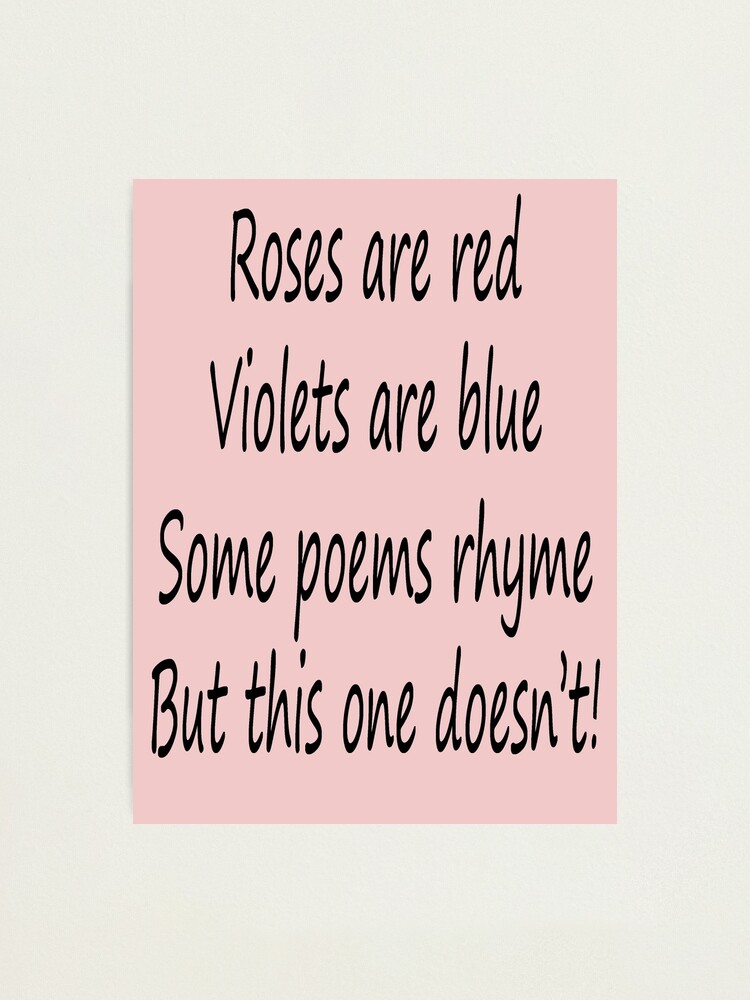
Many children and people learning English as a second language often don’t think of using poetry as a learning tool.
Most cultures are rich in cultural history, which includes poetry. According to Wikipedia, The earliest poetry is believed to have been recited or sung, employed as a way of remembering oral history, genealogy, and law. Poetry is often closely related to musical traditions, and the earliest poetry exists in the form of hymns (such as the work of Sumerian priestess Enheduanna) and other types of songs such as chants.
Learning English can be tricky, especially learning the grammar and pronunciation rules. Poetry looks quite different from a regular story or text.
There are some benefits for using poetry:
improves students’ writing, reading, speaking and listening skills in many different ways
widens students’ vocabulary and word choices
rhyming words help students remember new words
helps students practice intonation and stress of words and sentences
teaches students how punctuation can affect the poem
There are actually 15 different kinds of Poetic Forms:
Blank Verse
Rhymed Poetry
Free Verse
Epics
Narative Poetry
Haiku
Patoral Poetry
Sonnet
Elegies
Ode
Limerick
Lyric Poetry
Ballad
Soliliquy
Villanelle
Many people know about William Shakespeare. Besides being a famous playwright, he also wrote 154 sonnets. His sonnets were usually in a specific style: four stanzas, arranged in a rhyming scheme known as ABAB (the last word of the first line rhymes with the last word in the third line. The last word in the second line rhymes with the last word in the fourth line).
Shall I compare thee to a summer’s day? Thou art more lovely and more temperate: Rough winds do shake the darling buds of May, And summer’s lease hath all too short a date; Sometime too hot the eye of heaven shines, And often is his gold complexion dimm’d; And every fair from fair sometime declines, By chance or nature’s changing course untrimm’d; But thy eternal summer shall not fade, Nor lose possession of that fair thou ow’st; Nor shall death brag thou wander’st in his shade, When in eternal lines to time thou grow’st: So long as men can breathe or eyes can see, So long lives this, and this gives life to thee.
This is Sonnet 18
Modern poetry can look pretty different to poetry from the sonnets of the 17th Century.
Darkness.
I stop to watch a star shine in the boghole –
A star no longer, but a silver ribbon Thinking of my friend:
she lives in a foggy afternoon
in half of a white house.
One cat is slender black lightning
with bright citrus eyes,
the otehr is a vast baggy monster
and licks photographs
to savor the emulsion.
Counting the silver that weaves
in her crown, counting the teaboxes
in her kitchen, and one room
that houses nothing but a flat mat
and a bicycle.of light.
I look at it, and pass on.
(first stanza)
Cathy, 2000
It may seem daunting to read poetry at first, but if you give it a chance, you will love it!
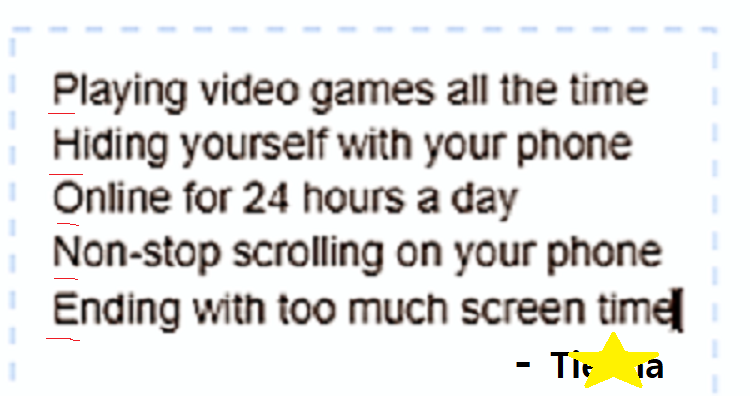
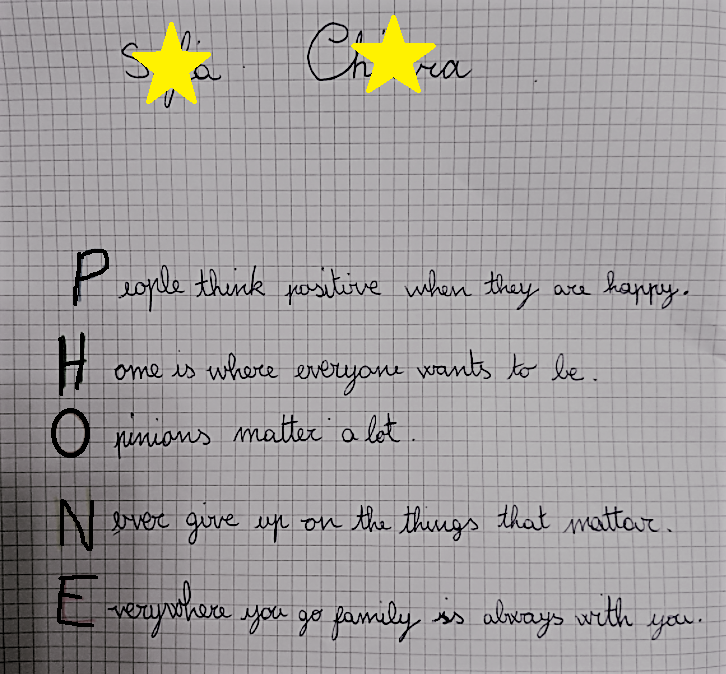
Here are two examples of ACROSTIC poems written by my ESL Students:
They use the letters in the word PHONE to start each line.
If you are looking for an ESL Tutor, please contact me to arrange a FREE 10-minute Meet and Greet.
Good is an adjective while well is an adverb answering the question ‘how?’. Sometimes well also functions as an adjective pertaining to health.
Examples: You did a good job. Good describes job, which is a noun, so good is an adjective.
You did the job well. Well is an adverb describing how the job was performed.
I feel well. Well is an adjective describing I.
Good vs. Well Rules
Rule: With the four senses—look, smell, taste, feel—discern if these words are being used actively to decide whether to follow them with good or well. (Hear is always used actively.)
Examples: You smell good today. Good describes you, not how you sniff with your nose.
You smell well for someone with a cold. You are sniffing actively with your nose here so use the adverb.
She looks good for a 75-year-old grandmother. She is not looking actively with eyes so use the adjective.
Rule: When referring to health, always use well.
Examples: I do not feel well today. You do not look well.
Rule: When describing someone’s emotional state, use good.
Example: He doesn’t feel good about having cheated.
So, how should you answer the question, “How are you?” If you think someone is asking about your physical well-being, answer, “I feel well,” or “I don’t feel well.” If someone is asking about your emotional state, answer, “I feel good,” or “I don’t feel good.”
An English Tutor can help you with your English Grammar. Contact me know to find out how.
The biggest problem with learning any language is a lack of confidence. It can stop learning and wanting to learn.
Here are some TIPS to help you:
Listen and Repeat: As you watch an English movie or news, listen to a sentence and then repeat it. Copy how the person says it.
Find a Friend: Sometimes it can be lonely to try and practice by yourself. Find a friend to practice with. Using a good English Tutor to keep lessons fun and interesting will also help you
Read out loud: Whether you enjoy reading a novel, a magazine or a newspaper. Aim at reading at least 30 minutes a day and then reading OUT LOUD another 30 minutes. This is more to practice confidence and less to focus on word knowledge and pronunciations.
Don’t be afraid of making mistakes: It’s okay to make mistakes. If you are stumbling over long words while speaking, pause a moment or take a break. Communicating in a second language is already a GREAT accomplishment!
Keep on practicing, I know you can do it!
If you are looking for some extra help, I offer online conversational classes where you can practice your English in the comfort of your own home.
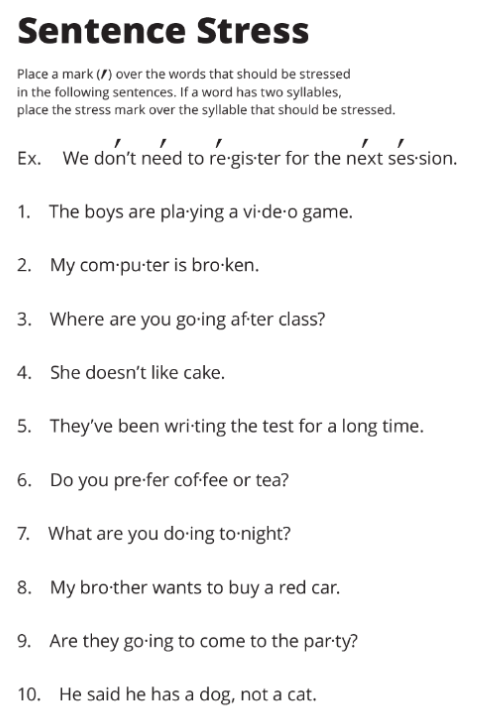
When you are learning and practicing a new language, it can be stressful at times. Pronunciations, grammar, vocabulary. Today, you will learn about SENTENCE STRESSES and why they’re important when speaking.
Sentence stress is what gives English its rhythm or “beat”. Sentence stress is an accent on certain words within a sentence. This is different from Word stress which is an accent on one syllable within a word.
Most sentences have two basic types of words:
content words These are the keywords of a sentence – essential words that carry the sense or meaning (the real content).
structure words These words are not very important. They are small, simple words that make the sentence correct grammatically and they give the sentence its correct structure.
If you remove the structure words from a sentence, you will probably still understand the sentence. But if you remove the content words from a sentence, you will not understand the sentence. The sentence has no sense or meaning.
e.g. SELL CAR GONE ITALY (Can you sell my car, because I have gone to Italy?)
We know that pronunciation is important, but sometimes we forget about sentence stress and intonation (the rise and fall of the voice in speaking). The rhythm and cadence of a language are important for clarity and fluency. Languages of the world vary greatly in sentence and word stress. Many languages stress content words (e.g. most European languages) while others are tonal (e.g. Thai) or have little to no word stress (e.g. Japanese). Practicing sentence stress in English helps you speak more quickly and naturally.
We stress content words because they are essential to the meaning of the sentence. In general, shorter words or words that are clear from the context don’t get stressed.
To Stress
Content words include nouns, verbs, adjectives, and adverbs. Negative words such as not or never also get stressed because they affect the meaning of the sentence. Modals, too, can change the meaning of a sentence. Here is a list of words to stress in an English sentence:
nouns (people, places, things)
verbs (actions, states)
adjectives (words that modify nouns)
adverbs (words that modify verbs, adjectives, other adverbs, or entire sentences)
negative words (not, never, neither, etc.)
modals (should, could, might, etc., but not will or can)
yes, no, and auxiliary verbs in short answers (e.g., Yes, she does.)
quantifiers (some, many, no, all, one, two, three, etc.)
Wh-Question words (what, where, when, why, how, etc.—note that what is often unstressed when speaking quickly because it’s so common)
Not to Stress
Here is a list of words that shouldn’t be stressed in an English sentence:
articles (a, an, the)
prepositions (to, in, at, on, for, from, etc.)
conjunctions (and, or, so, but, etc.)
personal pronouns (I, you, he, she, etc.)
possessive adjectives (my, your, his, her, etc.)
Be verb (am, is, are, was, were, etc.)
auxiliary verbs (be, have, do in two-part verbs or questions)
the modals will and be going to (because they’re common, and the future tense is often clear from context)
the modal can (because it’s so common)
Examples
The words (or syllables when the word has more than one) that should be stressed are in bold.